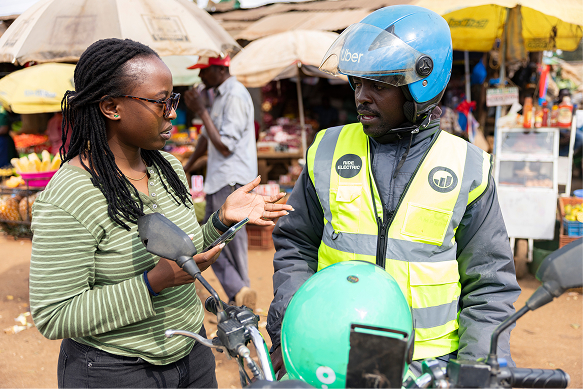

Motorcycles are already an important part of Nigeria’s transport economy. They move passengers, support deliveries and provide an income-generating asset for commercial riders across the country.
What is beginning to change is the kind of motorcycle that could perform those jobs.
Electric motorcycles are still at an early stage in Nigeria, but rising transport costs, improving economics, government policy and investment in charging and battery-swapping infrastructure are making them an increasingly important part of the country’s mobility conversation.
Nigeria’s transportation challenges
The World Bank review of urban mobility in Lagos, Kano and Abuja found that formal public transport remains weak or insufficient in many places, leaving privately operated minibuses, motorcycles and other informal transport services to fill important gaps.
The challenges go beyond the availability of vehicles. The World Bank identified the following as recurring problems across the cities studied:
- severe congestion
- poorly coordinated urban growth
- incomplete transport infrastructure
- high cost of commuting
In Kano, for example, transport can consume as much as 30% of household income. In Lagos, persistent congestion means the average commuter can spend as much as four hours travelling each day.
As cities expand, the problem also becomes one of reach. New residential areas frequently develop farther from jobs and services than existing public transport networks can comfortably serve. Thus, motorcycles and other informal transport providers become part of the system that connects people where formal services are limited.
That helps explain why motorcycles have become so consequential to everyday mobility in Nigeria. They are not a complete answer to the country’s transport problems. But their relatively small size, lower entry cost and ability to operate across routes that larger vehicles may not serve make them an important part of how people and goods already move.
The question for electric motorcycles is therefore not whether Nigerians will suddenly begin using two-wheelers. It is whether a large existing motorcycle economy can gradually run differently.
The motorcycle market in Nigeria
A 2026 Siemens Stiftung study on electric motorcycles in Nigeria estimates that between 10 and 15 million motorcycles are currently in operation across the country, with a large share being commercial motorcycles. For many riders in Nigeria, the motorcycle is an income-generating asset used to move passengers, make deliveries and support other forms of everyday commerce.
The demand for two- and three-wheel transport (where motorcycles comfortably sit) is also expected to grow. According to Nigeria’s Energy Transition Plan, the distance travelled by two- and three-wheelers is projected to rise from 47 billion vehicle-kilometres in 2020 to 84.49 billion by 2030.
The figures from these two studies point to the large market for two- and three-wheel transport within Nigeria, making the economics of motorcycle ownership potentially significant.
How electric motorcycles could change the outlook of the market
One of the most important costs for a commercial motorcycle rider is simply keeping the bike moving. Petrol is a major part of that expense. According to the National Bureau of Statistics’ PMS Price Watch, Nigerians paid an average of ₦1,051 per litre of petrol in February 2026. Today, in October 2026, that cost has increased to ₦1,340 per litre. For a rider who buys fuel every working day, petrol prices directly affect how much income remains after operating expenses.
Electric motorcycles can change that outlook. An analysis of electric mobility in Nigeria, conducted by RMI, finds that electric motorcycles already have a lower total cost of ownership than comparable internal-combustion motorcycles when purchase, energy and maintenance costs are considered. They also estimate that by 2040, the total cost of owning an electric motorcycle could be about half of an equivalent petrol motorcycle.
But lower running costs do not automatically make electric motorcycles affordable. An electric motorcycle can become cheaper to operate over time, but still remain harder for a rider to afford upfront at the beginning.
Electric mobility in Nigeria
Another report by RMI shows that Nigeria had around 20,000 electric vehicles by the end of 2025, with early adoption concentrated particularly in two- and three-wheelers, commercial fleets and other vehicles that spend significant time on the road.
In the same vein, battery-swapping networks are expanding in some commercial corridors, allowing motorcycle riders to exchange depleted batteries rather than wait for them to recharge. Report shows that Lagos went from only a handful of battery-swapping locations to more than 100 within roughly three years.
As for vehicle price, the Siemens Stiftung local-assembly study estimates that increasing local content beyond 25%, alongside local battery assembly, could substantially reduce production costs and create room for retail prices to fall by around 15%.
That matters because the transition will depend not only on whether electric motorcycles can be produced, but whether commercial riders can afford them.
Government support for electric mobility
Nigeria’s Energy Transition Plan identifies the electrification of two- and three-wheelers as part of the country’s longer-term transport transition. It identifies high initial EV costs, inadequate charging infrastructure and skills shortages among the barriers to adoption, while proposing incentives for electric two- and three-wheelers and companies investing in charging infrastructure.
The Nigerian Automotive Industry Development Plan also sets a target for 30% of locally produced vehicles to be electric by 2032 and includes measures aimed at increasing local automotive production. Tax policy is moving in the same direction. Nigeria’s 2024 VAT Modification Order exempts electric vehicles from VAT as part of a broader set of incentives for clean-energy technologies.
More recently, in March 2026, the Federal Government expanded the mandate of the Presidential Initiative on Compressed Natural Gas to include electric vehicles. According to the Nigerian State House announcement, the expanded PiCNG & EV initiative will coordinate electric-vehicle deployment, charging infrastructure and related investment.
These policies show that electric mobility is increasingly moving from isolated private-sector activity into Nigeria’s formal transport and industrial strategy.
What the market could look like in the years ahead
There are a couple of projections of what the market could look like for electric mobility.
Based on current vehicle and fuel economics, RMI estimates that electric motorcycles could account for as much as 70% of Nigeria’s two-wheeler market within the next 15 years if the infrastructure, financing and policy environment required for adoption continues to develop.
Nigeria’s Energy Transition Plan takes a longer-term view. Its transport model projects electric two- and three-wheelers growing significantly from around 2040 and eventually overtaking fossil-fuel models as battery performance, charging infrastructure and adoption improve.
What makes those projections interesting is the market electric motorcycles could enter.
Nigeria does not first have to create demand for two-wheel transport, since millions of motorcycles are already being used, and it is expected that the demand for two- and three-wheelers will continue rising.
The opportunity here is for electric motorcycles to become a practical alternative when riders, businesses and fleets are deciding what vehicle to acquire next.
What needs to happen for electric motorcycles to scale
The economics may be improving, but several practical problems still have to be solved before electric motorcycles can reach much wider adoption.
- Purchase prices need to become more affordable.
- Financing needs to become easier to access.
- The infrastructure for charging and battery swapping need to expand.
- Electricity needs to become more reliable.
- Maintenance and spare-parts networks need to grow.
- Battery performance needs to match how commercial riders work.
These challenges reinforce one another. Better infrastructure makes the bikes more practical. Local assembly can lower costs. A larger rider base improves the economics of battery-swapping networks. And financing can make the vehicle accessible to people who cannot pay the full purchase price upfront.
How M-KOPA is solving part of the problem
One of the biggest barriers to wider electric-motorcycle adoption in Nigeria is accessibility and affordability. This is the problem our financing model at M-KOPA is designed to solve. We work with Every Day Earners with fluctuating income, allowing them to make an initial payment (instead of paying the full cost of an asset upfront), begin using the asset, and continue paying for it through smaller repayments that better reflect how they earn.
We have already demonstrated that model at a significant scale in Nigeria. In February 2026, we unlocked more than ₦230 billion in credit for over one million Nigerian customers, making Nigeria our fastest-growing market. We have applied this flexible-financing approach to electric motorcycles, working with manufacturers including Roam, Ampersand and Spiro to help commercial riders access e-bikes without paying the full purchase price upfront.
The results show what becomes possible when financing and electric mobility come together. We have financed over 5,000 electric motorcycles in Kenya, with riders reporting average daily savings of KSh730 and 66% earning more after switching. By October 2026, that number increased to 10,000 electric motorcycles and three-wheelers financed in the market.
Nigeria already has millions of riders, growing demand for two-wheel transport and an emerging electric-mobility ecosystem. What many riders will still need is a practical path from wanting an electric motorcycle to being able to afford one.
We’re helping to close that affordability gap, using financing built around the realities of Every Day Earners.
Why electric motorcycles are the next big thing
Nigeria is dealing with congested cities, gaps in formal public transport, rising demand for mobility and millions of people who already depend on motorcycles to move passengers, goods and themselves.
For Nigeria, the promise of electric motorcycles is not simply that they run on a different source of energy. It is that they could improve the economics of a vehicle millions of people already depend on.
If the cost of access continues to fall and the supporting infrastructure keeps improving, electric motorcycles could move quickly from an alternative to a practical choice for everyday riders.