
For a motorcycle rider, petrol fumes can feel like an ordinary part of the job. Start the engine, enter traffic, spend hours on the road and repeat the same routine the next day. Unfortunately, those fumes are not harmless.
Petrol motorcycles release pollutants into the same streets where riders work, passengers travel and communities live. Electric motorcycles change that by removing the exhaust pipe altogether, while also reducing climate emissions, noise pollution, energy use and dependence on petrol.
For riders and the people around them, the impact is bigger than simply swapping a fuel tank for a battery.
What comes out of a petrol motorcycle?
A petrol motorcycle moves by burning fuel inside its engine. That process releases carbon dioxide (CO₂), which contributes to climate change, alongside pollutants such as carbon monoxide (CO), nitrogen oxides and particulate matter.
The smallest particles are particularly concerning because they can travel deep into the lungs and enter the bloodstream. The World Health Organization links exposure to fine particulate pollution with heart disease, stroke, respiratory disease and lung cancer. WHO estimates that outdoor air pollution contributed to about 4.2 million premature deaths worldwide in 2019.
Motorcycles are not the only source of dirty air. Cars, buses, trucks, generators, industry and road dust all contribute. But every petrol motorcycle adds another source of combustion pollution directly to the streets where people breathe.
Riders spend more time in traffic pollution
For commercial motorcycle riders, traffic is also a workplace. Many spend hours each day on congested roads and are repeatedly exposed to pollution from surrounding vehicles..
A Nigerian study comparing motorcyclists, taxi drivers and office workers found that commercial motorcyclists showed the greatest respiratory-function impairment among the groups studied, although the researchers also noted that other factors such as smoking, duration of exposure and place of residence can influence respiratory health.
Researchers studying motorcycle-taxi drivers in Cotonou, Benin, found something similar. Drivers whose working-day exposure to carbon monoxide exceeded 9 parts per million had significantly poorer peak expiratory flow, a measure of how forcefully someone can breathe out. The study was small, so it should not be read as proof that motorcycle riding itself causes respiratory disease, but it highlights the exposure faced by people who spend much of their working lives in traffic.
This is an important distinction when discussing e-bikes. Switching one motorcycle to electric will not remove the pollution coming from every other vehicle around the rider, but it does remove the exhaust that would have come from that motorcycle.
What changes when the bike goes electric?
Because it does not burn petrol while moving, an electric bike produces no tailpipe exhaust. That means no exhaust particulate matter or tailpipe carbon monoxide (CO) coming from the motorcycle itself. A Nairobi study of boda boda electrification confirms that electric motorcycles produce zero tailpipe emissions.
The environmental difference, however, goes further than the exhaust pipe.
Five ways e-bikes reduce environmental impact
1. Cleaner air at street level
Removing petrol combustion means removing one source of pollutants from the road.
Using real-world travel data from motorcycles in Nairobi, researchers estimated that switching from petrol to electric would eliminate particulate emissions from the motorcycles and avoid about 0.4 grams of particulate matter per bike each day. For one bike, that sounds small, but across thousands of commercial motorcycles operating day after day, it adds up.
The same researchers estimated that if Kenya's roughly 2.2 million boda bodas were electrified, tailpipe particulate emissions from those motorcycles could fall from about 847 kilograms per day to zero. They caution that scaling the estimate nationally is illustrative rather than a precise forecast, but it shows why removing many small exhaust pipes can have a large effect.
2. Lower climate emissions
An e-bike has no carbon monoxide emissions, but that does not mean its electricity is automatically carbon-free. The more useful comparison includes the emissions created when that electricity is generated.
Kenya performs particularly well on this measure because its electricity grid is relatively low-carbon. The Nairobi research estimated that replacing petrol boda bodas with electric motorcycles could reduce daily CO emissions by approximately 85% after accounting for electricity generation.
That percentage will not be the same everywhere. An e-bike charged from cleaner electricity will generally deliver a larger climate benefit than one charged on a grid heavily dependent on fossil fuels.
3. Less traffic noise
Petrol motorcycles do not only produce air pollution; their engines also add to urban noise. A research comparing electric and petrol motorcycles found that electric motorcycles can reduce people's exposure to excessive traffic noise in motorcycle-heavy cities.
That matters because noise is also a health issue. The World Health Organization says excessive environmental noise can disturb sleep and is associated with hypertension, cardiovascular effects, cognitive impairment and other health problems.
An electric motorcycle will not make a busy city silent because horns, cars, buses and road activity will still remain. But replacing thousands of combustion engines removes one significant source of constant street noise.
4. Less energy used per kilometre
Electric motorcycles are also much more energy-efficient. A recent before-and-after study followed commercial riders in Nairobi as they moved from petrol motorcycles to electric ones. Their median energy consumption fell from 1.09 megajoules per kilometre to 0.22, representing a 79.8% reduction in energy used per kilometre. Riders still travelled broadly similar daily distances and at similar speeds after switching.
Put simply, the electric motorcycle needed far less energy to do roughly the same work. For a commercial rider covering many kilometres every day, that efficiency is repeated on every trip.
5. Less petrol burned
There is also a very straightforward environmental benefit: every kilometre travelled electrically is a kilometre for which that motorcycle did not need to burn petrol. Electric motorcycles also have lower maintenance requirements than combustion bikes because there is no petrol engine requiring the same routine engine servicing.
E-bikes still require tyres, brakes, batteries and other maintenance, but the point is: throughout their working lives, they remove the continuous cycle of petrol combustion associated with a conventional motorcycle.
Cleaner bikes can mean healthier streets
The health benefit of an electric motorcycle does not stop with the rider. Every petrol bike removed from the road also removes one source of exhaust and engine noise from the people sharing that environment.
- Passengers no longer sit directly behind the exhaust of the motorcycle carrying them.
- Traders who spend hours by the roadside are exposed to fewer exhaust fumes as more bikes switch to electric.
- Pedestrians and traffic officers share the same roads and therefore benefit from having fewer combustion engines operating around them.
- People living near busy roads can also benefit from reduced engine noise as electric motorcycles become more common.
One electric motorcycle will not transform a city’s air or noise levels on its own. The bigger health benefit comes with scale: when hundreds or thousands of petrol motorcycles become electric, thousands of small sources of pollution disappear from the places where people work, travel and live.
E-bikes also have their downside
Electric motorcycles still have an environmental footprint.
- Batteries require materials and energy to manufacture.
- Sufficient electricity has to be generated.
- Batteries eventually need to be reused, recycled or disposed of.
- Tyres and brakes still create non-exhaust particles.
The Nairobi study estimates that electrifying Kenya's entire boda boda fleet could add around 6.85 GWh of electricity demand per day, although the researchers stress that the actual figure would depend on battery efficiency, charging methods and other assumptions. Their modelling also found that battery swapping could spread demand more evenly across the day than concentrated home charging.
So the case for e-bikes is not that they create no pollution or environmental cost at all. It is that the evidence shows they can substantially reduce several important impacts of petrol motorcycles, particularly when powered by relatively clean electricity.
Riders are already making the switch
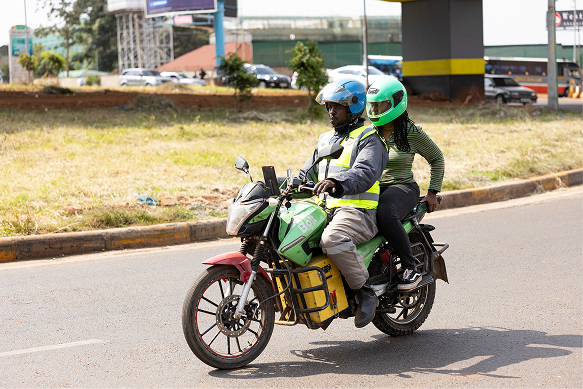
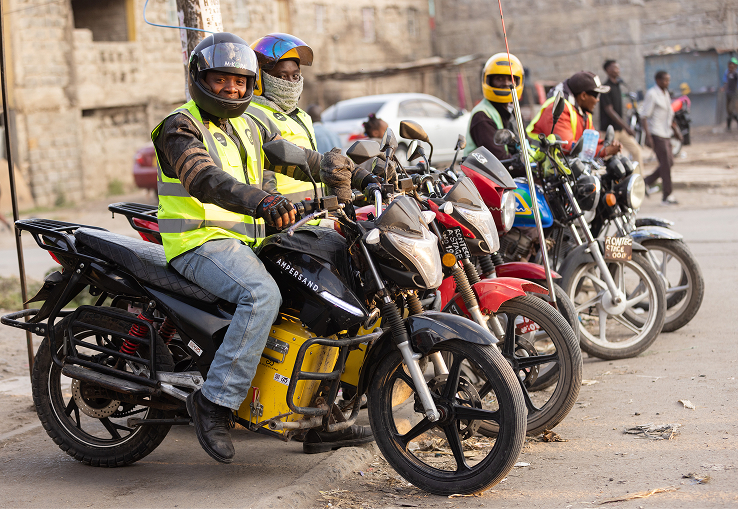
The transition is already happening in Kenya. Through our partnership with EV manufacturers like Roam, Spiro, and Ampersand, we have financed more than 5,000 electric motorcycles across the country, helping commercial riders switch through financing structured around the way they earn.
These e-motorbikes produce more than 90% fewer harmful pollutants (carbon monoxide, nitrogen oxides) than petrol alternatives. Our riders report average daily savings of KSh730 through lower energy spending, fewer repairs and efficient battery swapping, while 66% say they are earning more since switching.
That matters because cleaner transport will only reach a meaningful scale if it works for the people who depend on motorcycles to earn. The environmental benefit cannot remain something that makes sense only on paper while the cleaner vehicle remains unaffordable to the rider.
Conclusion
Fewer fumes, less noise and lower emissions can mean cleaner streets and healthier communities, especially as more commercial riders make the switch.
For riders considering electric, the impact starts with one bike and grows with every journey.
Explore M-KOPA Mobility to learn more about making the switch.