
Owning a smartphone can make it easier to find customers, access information, use financial services and participate in the digital economy. Yet women across Sub-Saharan Africa are still less likely than men to own one.
The latest GSMA data puts the smartphone ownership gender gap in Sub-Saharan Africa at 22%, with affordability, digital skills and safety among the barriers that continue to affect women disproportionately. Closing that gap therefore takes more than putting smartphones on shop shelves.
Women need devices they can afford, payment models that fit their incomes and, in many cases, someone they trust to explain how everything works. That is where our network of more than 40,000 sales agents across 5 countries becomes an important part of the story.
The smartphone gender gap in Ghana and Uganda
A 2024 digital-inclusion assessment estimated that 46% of women in Ghana owned smartphones compared with 63% of men, a difference of 17 percentage points. This shows that Ghana’s smartphone market is growing quickly overall but growth does not automatically mean equal access.
The GSMA’s 2026 Mobile Gender Gap Report puts Uganda’s smartphone ownership gender gap at 26%, one of the widest among the countries it surveyed. Basic phones also remain common: 48% of Ugandan women still own a basic phone as their most advanced device.
Among Ugandans who own smartphones, 93% of men and 83% of women use mobile internet, far higher than among people relying on basic or feature phones. The smartphone is therefore an important step towards getting online, even though ownership alone does not remove every gender barrier.
Why are women less likely to own smartphones?
There is no single explanation. Several barriers can sit on top of one another.
- High cost of smartphones: Women often have lower or less predictable incomes, making a large upfront smartphone purchase more difficult. GSMA continues to identify phone affordability as one of the biggest barriers to mobile-internet adoption.
- Lack of digital skills: Someone who has spent years using a basic phone may hesitate to pay more for a smartphone if they are unsure how to use apps, mobile data or online services.
- Safety and trust matter. Concerns about scams, privacy and online harassment can make women more cautious about unfamiliar digital products and services.
- Inconvenient access: Distance, transport, caregiving responsibilities and the time required to visit a store or service point can create additional friction.
The World Bank argues that closing the gender digital divide requires a broader approach, including affordable smartphone financing, safer access points and digital-skills support designed around women’s circumstances.
Financing removes the first big barrier
For many women, the first problem is not whether they want a smartphone but being able to buy one upfront. At M-KOPA, we change that narrative by allowing eligible customers to make a smaller initial payment and then pay for the device in manageable instalments instead of saving for months before they can start using it. Across our 5 markets (Ghana, Kenya, Uganda, Nigeria, and South Africa), 81% of female customers surveyed said they could not have afforded a smartphone without M-KOPA.
In Ghana, 41% of female customers said their M-KOPA smartphone was their first smartphone, compared with 36% of customers overall. Today, 37% of newly acquired Ghanaian customers are women. In Uganda, 53% of surveyed customers purchased their first smartphone through M-KOPA. This shows that financing is reaching a large population of first-time smartphone owners in a country where women remain especially underrepresented.
Getting the phone is not the whole journey
A first-time smartphone buyer may still have very practical questions. For example, How do payments work? Which phone can I afford? What happens if I have a slow week? How do I set up the device? How do I pay safely? What other services come with the phone? This is where a physical sales network can do something an online checkout page cannot.
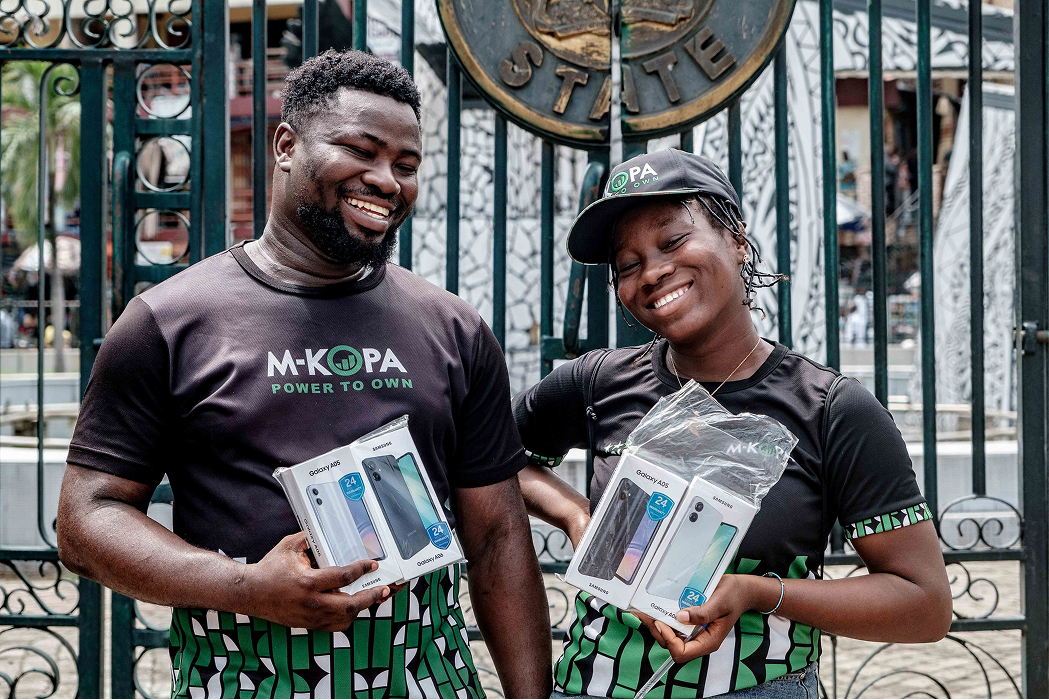
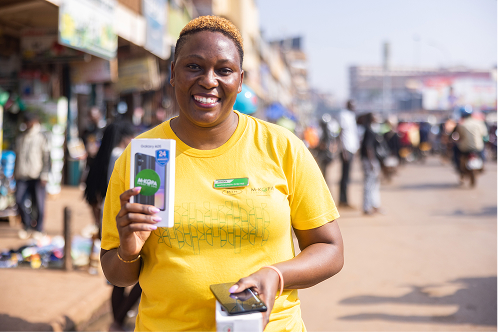
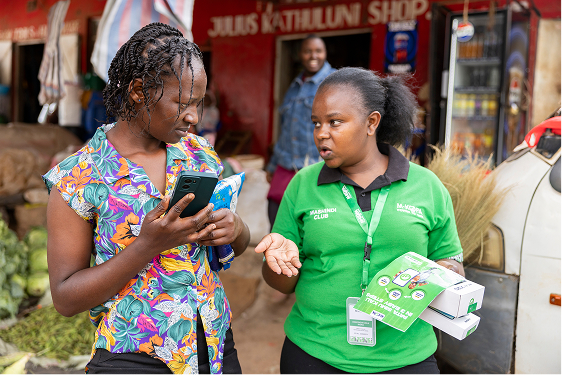
From our network of over 40,000 sales agents across five countries, there are more than 3,000 in Ghana and more than 3,500 in Uganda. These sales agents are representatives who help our customers understand credit and navigate basic smartphone applications rather than simply handing over devices.
Mariam Nambi’s experience in Maya, Uganda captures that human role well. When she bought his first M-KOPA smartphone, she says the sales agent explained the process thoroughly before she paid her deposit and received the phone. That explanation matters for someone making a first move into smartphone ownership.
Why our agent model works
The M-KOPA agent model has been making smartphone access easier in several practical ways. Among many things, our agents:
- Bring the product closer — Instead of requiring every customer to navigate an unfamiliar digital buying journey, we have agents operating within the markets and communities we serve.
- Explain the payment model — A customer can understand the deposit, repayment expectations and ownership journey better in person before committing.
- Support first-time users — Someone moving from a basic phone can ask questions rather than being left alone to figure everything out by themselves.
- Create a human point of trust — Our agents serve as the human contact with our customers. This becomes particularly important for customers who may be wary of unfamiliar financial or digital services.
Also, we’re beginning to make our agent network more intentionally responsive to women. In Ghana, we trained agents to engage female customers more effectively, while lower-cost devices are being deployed in rural and peri-urban areas where affordability is especially challenging. Stationary kiosks have also been piloted partly in response to safety concerns faced by female sales agents.
More women are getting connected
More female entrepreneurs are using their smartphones as a business tool, and M-KOPA customers are not left behind.
In Ghana, fried-yam seller Gloria Afortey uses her M-KOPA smartphone to advertise her food through TikTok and WhatsApp. She says her daily income increased from around GH₵500 to GH₵700–800, with the additional profit helping her buy more yam, oil and fish for the business.
In Uganda, Susan runs both a drug shop and a family bakery. Losing her old smartphone meant she could no longer take orders, follow up with patients or advertise cakes. After accessing another smartphone through M-KOPA, she was able to reconnect with customers and begin taking orders through WhatsApp again. She later became eligible for a UGX500,000 digital loan, which she used to buy a larger bakery mixer and restock her drug shop.
Stories like these show why the gender gap is not really about owning a better phone for its own sake. It is about who gets access to the opportunities sitting behind the screen.
The impact is a two-way street
At M-KOPA, we don’t only have women as customers, they are increasingly part of the distribution network itself. Across our network, women make up around 45% of all sales agents. In Ghana, female representation among agents has risen from 26% to 31%, while 84% of agents overall say they earn more since joining us.
Peace, an M-KOPA agent in Ghana and a single mother, says income from the role has allowed her to support her daughter through senior high school and university, and to also rent a home of her own.
In Uganda, we work with more than 3,500 sales agents across the country, creating a nearby, human point of contact for customers who may be buying a smartphone on finance for the first time.
The point is not that agents alone close the gender gap. It is that local, trusted distribution can make access less intimidating, while greater female participation in that network helps make the journey more inclusive from both sides.
Conclusion
For women in Ghana and Uganda, the path to greater digital inclusion is both access and affordability. While affordable financing gets the smartphone closer to them, our local agents help make the journey understandable. And once women are connected, the smartphone becomes a way to find customers, manage a business and access opportunities that were harder to reach before.
With a 40,000-strong agent network already operating across 5 African countries, we have an opportunity to keep narrowing that gap one customer and one smartphone at a time.
Want to join the M-KOPA agent network? Contact us on how to get started.