



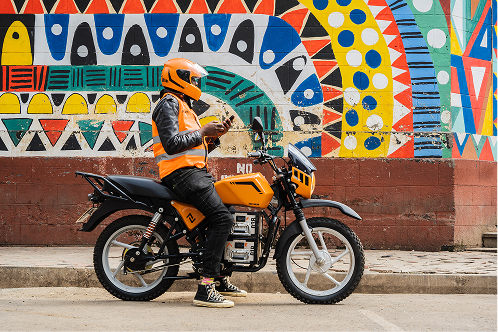
In three years, Kenya went from 700 electric vehicles to 25,000—a 3,000% explosion. At the center of this revolution are 5,000+ electric boda bodas financed by M-KOPA, and the riders who are discovering that going green means earning more. Here's the inside story of Africa's e-mobility transformation.
It's 5:30 AM at a battery swap station in Nairobi's Central Business District. The matatu stage is waking up, but something's different. Instead of the deafening roar of two-stroke engines, there's a soft hum. Electric motors. Dozens of them.
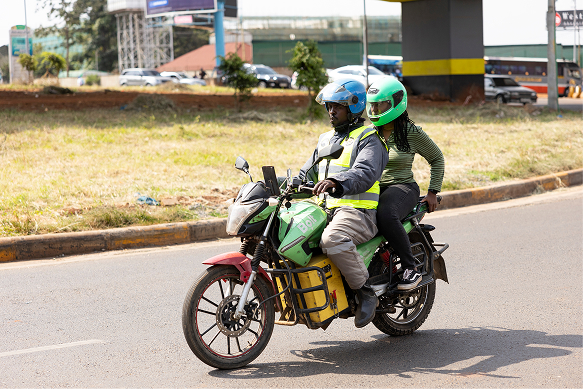
A rider in a yellow helmet pulls up in his Roam Air e-bike, swaps his depleted battery for a fully charged one in 90 seconds, and speeds off to catch the morning rush. No petrol station. No fumes. No noise.
"I'm making an extra KES 500 per day since I switched to electric," he says, doing the mental math. "That's KES 15,000 extra per month—enough to move my daughter to a better school."
This is the sound (or rather, the quiet) of Kenya's electric vehicle revolution. And it's moving faster than anyone predicted.
From a paltry 700 EVs in 2022, Kenya now boasts nearly 25,000 registered electric vehicles. That's a 3,000% explosion in 3 years. Most of these are motorcycles—the ubiquitous boda bodas that form the circulatory system of Kenya's economy.
And M-KOPA has financed over 5,000 of them since 2023.
This isn't just an environmental story. It's an economic revolution. Riders are earning more. Cities are breathing cleaner air. And Kenya is positioning itself as Africa's e-mobility leader.
Why Riders Are Making the Switch
Let's cut to what matters most to boda boda riders: money.
A typical petrol boda boda rider in Nairobi earns KES 2,500-5,300 ($20-$40) per day before expenses. Sounds decent, until you subtract:
- Fuel: KES 500-800 ($4-6) per day
- Maintenance—oil changes, spark plugs, repairs: KES 200-400 ($1.50-3) per day
- Parking/bribes: KES 100-200 ($0.75-1.50) per day
After expenses, take-home income: KES 1,750-4,000 ($14-30) per day.
Now let's look at an electric boda boda rider whose daily earnings is same as that of a petrol bike rider: KES 2,500-5,300 ($20-40)
Expenses:
- Battery swaps: KES 300-500 ($2-4) per day
- Maintenance—electric bikes have fewer moving parts: KES 50-100 ($0.40-0.75) per day
- Parking/bribes: KES 100-200 ($0.75-1.50) per day
After expenses, take-home income: KES 2,100-4,700 ($17-35) per day.
The difference: an extra KES 400-700 ($3-5) per day, or KES 11,000-20,000 ($90-150) per month.
That's not a small difference. That's school fees. That's rent. That's savings. That's moving your family forward.
Brian Njao, General Manager of M-KOPA Mobility, puts it simply: "Riders earn an extra five dollars daily. Over a month, that's groceries, school fees, or, in one rider's case, moving a child to a better school."
This is why riders are switching. Not because they're environmentalists (though many appreciate the cleaner air). Not because the government told them to. But because electric bikes make economic sense.
Battery Swapping Changes Everything
Here's the problem that killed early e-mobility efforts: charging time.
If you're a boda boda rider, you can't afford to wait 4-6 hours for your bike to charge. You need to be on the road, earning money.
Enter battery swapping.
Instead of charging your bike, you swap your depleted battery for a fully charged one at a swap station. The process takes 90 seconds—less time than refueling with petrol.
Kenya now has hundreds of battery swap stations across Nairobi, Mombasa, Kisumu, and other cities. Companies like Roam, Ampersand, and Spiro have built the infrastructure. M-KOPA finances the bikes.
"It's a chicken and egg scenario," Njao explains. "If you bring a thousand bikes without swapping stations, you're stuck. If you spend on a thousand stations without bikes, your CapEx is gone."
The balance is delicate, but right now, it's working. Demand is outpacing supply. Riders want e-bikes faster than manufacturers can produce them.
How M-KOPA Makes E-Bikes Accessible
Here's the catch: electric motorcycles cost KES 150,000-250,000 ($1,150-1,900)—significantly more than petrol bikes KES 80,000-120,000 ($600-925).
For a rider earning KES 2,500-5,300 ($20-$40) per day, that upfront cost is impossible.
This is where M-KOPA's pay-as-you-go model becomes revolutionary.
Here's how it works:
Step 1: Small Deposit
Riders pay a deposit (often KES 20,000-40,000) and take the e-bike home immediately.
Step 2: Daily Mobile Money Payments
Riders pay daily via M-Pesa or Airtel Money. The amount is affordable—usually KES 500-800 per day, which is less than they were spending on petrol.
Step 3: Missed Payment = Locked Bike
Miss a payment, and the bike locks remotely. No accumulation of crippling debt. No repossession drama. Just a simple lock until you catch up.
Step 4: Own the Bike
After 12-18 months of consistent payments, the bike is yours. You've built a credit history. You own an asset. You're earning more than ever.
"If that bike is not active on the road, that customer will not pay us," Njao says. "We have a symbiotic relationship."
This alignment of incentives is crucial. M-KOPA succeeds when riders succeed. The repayment rates on e-bikes sit above market average—proof that the model works.
Guaranteed Income for E-Bike Riders
Another innovation that's accelerating adoption is partnerships with ride-hailing platforms.
Bolt, the ride-hailing giant, now has 5,808 EVs on its platform—accounting for nearly a quarter of all electric vehicles in Kenya. More strikingly, 40% of Bolt's two-wheeler fleet is already electric.
M-KOPA's partnership with Bolt is straightforward:
- Riders on the Bolt platform pay less for their e-bike loans
- Bolt gets guaranteed supply of electric bikes
- Riders get steady trip income from the platform
The customer wins twice: lower asset costs and steady income.
For riders, this removes the biggest risk of boda boda work i.e. inconsistent income. With Bolt, they have a steady stream of ride requests. Doing this with an e-bike, they have lower operating costs. The combination is powerful.
Clean Air, Healthy Cities
Petrol boda bodas spew exhaust directly into the rider's face. After a 10-hour shift, riders go home with headaches, sore throats, and irritated lungs. Long-term exposure causes respiratory diseases, heart problems, and even cancer.
On the other hand, electric bikes produce zero emissions. Riders breathe clean air. So do passengers and pedestrians.
Nairobi's air quality is notoriously bad—ranked among the worst in Africa. Motorcycle exhaust is a major contributor. As more bikes go electric, the air gets cleaner.
This isn't just feel-good environmentalism. It's public health. It's quality of life. It's riders coming home without headaches. It's children playing near roads without inhaling toxic fumes.
One rider puts it simply: "I used to cough all the time. Now I don't. That alone is worth it."
Policy Driving Adoption
Kenya's government deserves credit for creating an enabling environment:
Tax Incentives:
- Zero VAT on electric bikes and lithium-ion batteries
- Reduced import duties on EVs
- Tax breaks for EV manufacturers and assemblers
Infrastructure Support:
- Green number plates for EVs (making them instantly recognizable)
- Preferential treatment at some matatu stages
- Public charging stations in government buildings
Policy Framework:
- National Electric Mobility Policy launched in 2026
- Target: EV sales to match petrol vehicles by 2042
- Vision: Kenya as Africa's e-mobility hub
"If you're an electric bike in a stage, there's a higher likelihood a customer will go for it," Njao says. Visibility matters. Green plates signal modernity, environmental consciousness, and lower operating costs.
But there's a catch—one the government doesn't like to talk about.
The Billion-Shilling Problem: The Fuel Levy Crisis
Here's the part that keeps policymakers awake at night: Kenya funds its roads through a fuel levy—KES 25 per liter of petrol. More EVs mean less fuel consumption. Less fuel consumption means collapsing revenue.
The numbers are stark:
- 2025: KES 2 billion shortfall due to EV transition
- 2037: Fuel tax collections will start declining
- 2043: KES 89.5 billion annual shortfall (about $688 million)
Every electric bike Kenya celebrates inches the country closer to a fiscal cliff.
Transport Cabinet Secretary, Davis Chirchir acknowledges the problem, vaguely promising "alternatives" like road-use charges or electricity levies. But for now, the policy framework accelerating EV adoption contains no concrete plan for replacing the fuel money evaporating with every swapped battery.
This is the paradox of progress: the same revolution saving riders money is quietly blowing a hole in Kenya's budget.
For riders, this isn't their problem—yet. But eventually, the government will need to find new revenue. Road-use charges? Per-kilometer fees? Electricity taxes? Whatever the solution, it will affect e-bike economics.
For now, though, riders are enjoying the benefits while they last.
Women's Opportunity: Breaking Barriers in E-Mobility
Boda boda riding has always been male-dominated. Less than 5% of motorcycle taxi riders are women. The barriers are real: safety concerns, social stigma, physical demands, harassment.
But electric bikes are changing this equation.
Why Women are More Open to E-bikes
- Cleaner: No grease, no oil, no fumes
- Quieter: Less intimidating, more socially acceptable
- Safer perception: Modern, tech-forward image
- Lighter: Easier to handle (no kick-start, smoother acceleration)
- Professional: Green plates signal legitimacy
While women are still a small minority of e-bike riders, the numbers are growing. And M-KOPA is actively recruiting female riders and agents.
We want to see more women in e-mobility. The barriers are lower with electric bikes and it's an opportunity to diversify the industry. For women, e-bikes represent economic opportunity without some of the traditional barriers of motorcycle taxi work.
Rider Stories
James, Nairobi
James has been a boda boda rider for eight years. He switched to electric six months ago. "I was skeptical at first," he admits. "But the savings are real. I'm taking home KES 15,000 more per month. I've started saving for the first time in my life."
Peter, Mombasa
Peter rides for Bolt. "Customers prefer electric bikes," he says. "They're quieter, smoother, no exhaust smell. I get more five-star ratings, which means more trips. Plus, I'm spending half what I used to on fuel."
David, Kisumu
David was worried about range anxiety. "What if the battery dies in the middle of a trip?" But after three months, he's confident. "There are swap stations everywhere. I've never been stranded. And the bike is so much easier to maintain—no oil changes, no spark plugs, no carburetor problems."
Samuel, Nairobi
Samuel is paying off his e-bike through M-KOPA. "The daily payments are less than I was spending on petrol," he says. "In one year, I'll own the bike. Then my income will jump even more because I won't have payments."
These aren't exceptional cases. They're the everyday reality of Kenya's e-mobility revolution.
Scaling Across Africa
Kenya is just the beginning.
M-KOPA's next moves are already mapped: densify Nairobi, launch Mombasa properly, then eye Uganda, Nigeria, and Ghana.
The solar and smartphone business proved that the pay-as-you-go model works across borders. Njao believes mobility will follow.
"If we can have smartphones working in five countries, we can have electric mobility working there too," he says.
The Opportunity is Massive
- Nigeria: Millions of okada riders, growing environmental concerns, government interest in e-mobility
- Uganda: Expanding boda boda market, supportive government policies
- Ghana: Growing urban transportation needs, environmental awareness
- South Africa: Mature market, strong environmental regulations, high fuel costs
Each market has unique challenges in terms of infrastructure, regulations, rider economics, and cultural factors. But the fundamental model is proven:
Lower operating costs + Flexible financing = Rider adoption
Your Turn: Join the E-Mobility Revolution
If you're a boda boda rider still using petrol, ask yourself these questions:
>> How much am I spending on fuel every day?
KES 500? KES 800? KES 1,000?
>> How much am I spending on maintenance?
Oil changes, spark plugs, carburetor repairs, engine problems?
>> How much can I save with an electric bike?
KES 15,000 per month? KES 20,000? More?
>> What can I do with that extra money?
Pay school fees? Save for a house? Start a side business? Move your family forward?
The math is simple. The opportunity is real. And the time is now. Here's what you need to do:
Step 1: Visit M-KOPA
Find your nearest M-KOPA agent or go to www.m-kopa.com/country/kenya
Step 2: Choose Your E-Bike
Select from multiple models (Roam, Ampersand, Spiro, others)
Step 3: Pay Your Deposit
Small deposit (KES 20,000-40,000) gets you on the road immediately
Step 4: Start Earning More
Make daily mobile money payments (less than you were spending on petrol)
Step 5: Own Your Bike
After 12-18 months, the bike is yours—and you're earning more than ever.
Don't wait. Every day you delay, you're losing money to petrol.
Join the 5,000+ riders who've already made the switch.

.svg)


