



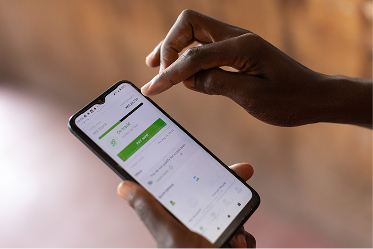
Many Every Day Earners have fluctuating incomes: a trader can have a great weekend and a quiet Tuesday; a rider can complete twenty trips today and only ten tomorrow: a farmer may earn most of their income during particular seasons. This can create moments when there is not enough cash available today, even though more money is expected soon.
This is where a digital loan can help bridge that gap. The important thing is knowing whether you are dealing with a temporary cash-flow gap or a deeper problem that borrowing cannot solve.
What is income volatility?
Income volatility (or irregular income) simply means that the amount of money you earn goes up and down over time. Someone earning a fixed salary may know that KSh50,000 will enter their account at the end of every month. An Every Day Earner may eventually make the same KSh50,000 over a month, but receive KSh1,000 today, KSh3,000 tomorrow, nothing on Wednesday and much more over the weekend.
Research from FSD Kenya followed business owners every week for a year and found that their revenues and expenses often changed in unpredictable ways from month to month. The same research found that when small firms needed credit, working capital (money needed to keep the business operating) was often more important than money for large investments.
As an Every Day Earner whose expenses may not move with your income, that mismatch between when money comes in and when money needs to go out is the gap digital credit can sometimes help you manage.
How digital loans can bridge the gap
A digital loan is most useful when there is a clear, temporary gap and you already have a reasonable idea of where the repayment money will come from.
Here are some of the ways a digital loan can help manage these gaps caused by irregular income:
1. Keep your business stocked
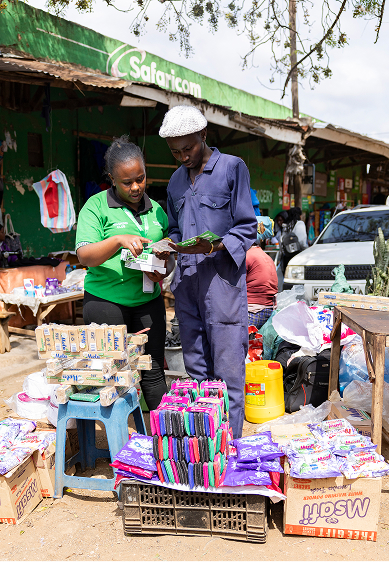
Imagine you normally spend KSh5,000 buying stock on Monday and recover that money through sales during the week, then one unusually slow weekend leaves you with only KSh3,000. Without additional cash, you may buy less stock, which means you also have less to sell when customers return. In this case, a small loan can provide the missing KSh2,000, allowing your normal earning cycle to continue.
This was part of the challenge faced by Kenyan trader Lydia Wangui Nderitu. When she was selling porridge around Makina, each day's earnings determined how much raw material she could afford for the following day. After building a credit history with us, she became eligible for a KSh7,000 digital loan that she used as business capital. Over time, she moved from hawking porridge to operating from a physical location and making deliveries.
2. Fix something that helps you earn
Sometimes an income gap is created by an unexpected expense, For example., if a boda boda rider's motorcycle breaks down, waiting two weeks to save for the repair may mean losing two weeks of income. If the rider can afford the repair through a manageable loan and then repay it from future trips, borrowing can help protect their source of income.
The same principle could apply to replacing an essential business tool, repairing equipment or dealing with another problem that prevents you from working. In these situations, the question is whether the cost of borrowing is reasonable compared with the income you might lose by doing nothing.
3. Take an opportunity before it disappears
Income volatility can also make it difficult to take advantage of good opportunities. For example, a food vendor might receive a large catering order but need money for ingredients before the customer pays. A trader might have a chance to buy stock at a temporary discount. Someone may receive more customer orders than usual but lack enough working capital to fulfil them.
The FSD Kenya research found that Kenyan firms often need working capital precisely because a lack of available cash can force them to give up opportunities even when their underlying businesses are viable. Therefore, a short-term loan can help when the opportunity itself provides a reasonably clear route to repayment.
4. Get through an unusually slow period
Not every bad week means your business is failing, because other factors may abound: weather can reduce customers, seasonal demand can fall, work may temporarily dry up, a customer might delay a payment you were expecting. This is where the idea of “smoothing” becomes useful.
Research on Kenya's M-Shwari digital-credit service found that access to digital loans made households facing negative shocks 6.3% less likely to forgo expenses. The researchers concluded that digital credit improved households' ability to cope with shocks, while also warning that loans are not a solution to every financial problem.
If your income usually recovers and you can see how the loan will be repaid, borrowing can give you breathing room when you find yourself in a similar situation.
5. Handle an urgent household expense without emptying the business
For many Every Day Earners, household and business money often sit very close together. When school fees, health costs or another urgent expense appears, the easiest option may be to take money from the business. The danger is that spending tomorrow's stock money today can weaken the business that produces the family's income.
Ugandan M-KOPA customer Joseph Kayondo, for example, combines farming with his work as an Uber driver and has used M-KOPA digital loan for both his children's school fees and his businesses. In situations like this, access to short-term credit can provide another option when an important expense and available cash do not line up.
Before you borrow
The most important question to ask yourself before you borrow should be: “Is the gap temporary?” Suppose your business normally makes enough money to cover its costs, but a customer who owes you KSh10,000 will not pay until Friday. Needing KSh3,000 on Tuesday may genuinely be a timing problem.
Now imagine that your expenses have exceeded your income every week for three months and you need a new loan whenever the previous one is repaid. That is different. You may have an income or spending problem rather than income volatility.
Borrow to bridge the gap
Being offered KSh20,000 does not mean you need KSh20,000. If KSh5,000 solves the immediate problem, borrowing four times as much means taking on interest and repayments for money that was not necessary. The repayment also becomes another expense your future income must carry.
At M-KOPA, our financing model starts eligible customers with smaller loan amounts that can increase as they build a credit history with us. The aim is for customers to progressively demonstrate what they can manage rather than beginning with the largest possible amount.
In Nigeria, for example, Adewunmi started with loans of ₦10,000 and later ₦20,000. As she continued making repayments, her credit history grew, and she now uses our digital loans to manage uneven income, invest in inventory and handle unexpected expenses.
Before accepting a loan
Digital credit is convenient, which makes it especially important to notice when a useful tool is becoming a habit.
Before accepting a loan, ask yourself:
- What exactly am I borrowing for?: You should be able to name the income gap the money is solving.
- Where will the repayment come from?: Identify expected sales, earnings or another realistic inflow.
- How much do I actually need?: Borrow for the gap rather than simply taking the maximum loan amount offered.
- What will remain after I repay?: Future income still has to cover food, transport, rent, stock and other expenses, so put these into consideration.
- Am I borrowing to repay another loan?: If this happens repeatedly, it is a warning that the underlying problem may no longer be temporary.
Conclusion
Income volatility is part of everyday life for many traders, riders, farmers, service providers and small-business owners. For an Every Day Earner, income volatility may simply mean the money you need today will only become available later.
It is in these moments that digital loans can help by keeping stock on the shelf, getting an income-producing asset working again, allowing you to take an opportunity or helping you manage an urgent expense without immediately draining your business.
The key is to understand the cost and borrow only what you need.
Remember: Do not borrow your way through every difficult day, Use credit carefully so that a temporary cash-flow gap does not become a longer-term debt problem.




.svg)


