



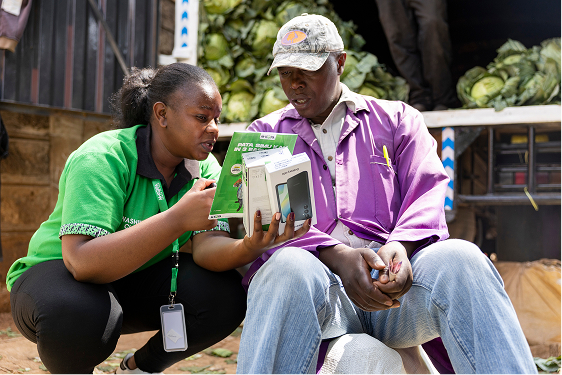
The digital divide isn't just about technology. It's about opportunity. And for 1.7 million people across Kenya, Uganda, Nigeria, Ghana, and South Africa, one smartphone changed everything.
It's 6:30 AM in Lagos, and Suliyat is already at her market stall, arranging bags of rice. Her phone buzzes—a WhatsApp message from her supplier in Kano. She quickly confirms her order, checks her mobile money balance, and posts a quick video of her fresh stock on TikTok. By 8 AM, three customers have already messaged her to reserve bags.
Five years ago, this morning routine would have been impossible. Suliyat didn't own a smartphone. She couldn't afford one.
"When I found out the M-KOPA deposit was just ₦40,000, I paid immediately." She recalls. "With the money I had been saving, I bought more rice for my business. Now, I can pay the kids' school fees and grow my business. With my smartphone, I keep in contact with suppliers, manage my salesgirls, and even post videos of my food on TikTok."
Suliyat is one of 1.7 million first-time mobile internet users who gained digital access through M-KOPA's device financing model. Her story isn't unique—it's being replicated across five African countries, where everyday earners are discovering that a smartphone isn't a luxury. It's a lifeline.
Understanding Africa's Digital Divide
76% of Sub-Saharan Africa doesn't own a smartphone.
In 2026, while the rest of the world scrolls, streams, and shops online, three out of four Africans are locked out of the digital economy. Not because they don't want smartphones. Not because they don't understand their value. But because they simply can't afford them.
The math is brutal. An entry-level smartphone costs up to 95% of a low-income earner's monthly wages in Sub-Saharan Africa. For a market trader earning ₦50,000 a month in Nigeria, or a boda boda rider making KES 15,000 in Kenya, spending ₦47,500 or KES 14,250 upfront on a phone is financial suicide.
So they wait. They save. They watch their competitors—the ones with smartphones—pull ahead. They lose customers who prefer WhatsApp orders. They miss out on mobile money opportunities. They remain invisible to the digital economy that's reshaping Africa.
Until now.
How Device Financing Rewrites the Rules
M-KOPA didn't invent the smartphone. But we did something arguably more revolutionary: we made it accessible.
Our model is elegantly simple. Instead of paying ₦100,000 upfront for a smartphone, you pay a small deposit—sometimes as low as ₦40,000—and take the phone home immediately. Then you make small daily, weekly, or monthly payments through mobile money. Miss a payment, and the phone locks until you catch up. Complete your payments, and the phone is yours forever.
It's the same pay-as-you-go model that brought solar power to millions of African homes. And it's working just as powerfully for smartphones.
The numbers tell the story:
- $2 billion+ in credit unlocked across five markets
- 7 million+ customers and counting
- 290,000 first-time smartphone users in Nigeria alone
- 36% of M-KOPA Ghana customers said their M-KOPA smartphone was their first phone
- 41% of women customers in Ghana were first-time smartphone owners
But statistics only tell half the story. The other half is written in the daily lives of people like Suliyat, who are using their smartphones to rewrite their economic futures.
When Connectivity Becomes Currency
Here's what happens when an everyday earner gets their first smartphone:
Within the first month, they're using WhatsApp to communicate with customers and suppliers. No more expensive phone calls. No more missed opportunities because they couldn't be reached.
Within three months, they've discovered mobile money. They're sending and receiving payments digitally, reducing the risk of theft and the hassle of handling cash.
Within six months, they're using their phone as a business tool—taking photos of products, posting on social media, accessing market information, managing inventory through simple apps.
Within a year, their income has grown.
The data backs this up. 54% of M-KOPA customers earn more after getting a smartphone. In Ghana, 55% use their device for income generation. In Nigeria, 77% of customers use their smartphones or digital loans to generate income.
Smartphones don't just connect people to the internet, they connect them to economic opportunity.
Closing the Gender Gap, One Phone at a Time
If you're a woman in Sub-Saharan Africa, the digital divide is even wider.
Women are 15-20% less likely to own smartphones than men. They face additional barriers: lower incomes, less control over household finances, social norms that prioritize men's technology access, and safety concerns about using digital platforms.
But M-KOPA's model is changing this equation. In Ghana, 41% of women customers were first-time smartphone owners—higher than the overall average. In Nigeria, women's customer participation grew from 29% in 2024 to 33% in 2025. And women now represent 53% of M-KOPA's active sales agents in Nigeria.
Why? Because the pay-as-you-go model removes the biggest barrier: upfront cost, and the agent network provides trusted, localized support that addresses women's specific concerns.
Peace, an M-KOPA agent in Ghana, explains: "It was difficult to support my daily expenses with my previous job at a restaurant. I am a single mother, and it was difficult to take care of my daughter. Now, I have been able to take care of my daughter from senior high school to university. I can rent a place of my own."
Peace isn't just selling phones. She's opening doors for other women, showing them that digital access is possible, affordable, and transformative.
Building Digital Confidence
Getting a smartphone is one thing. Using it effectively is another.
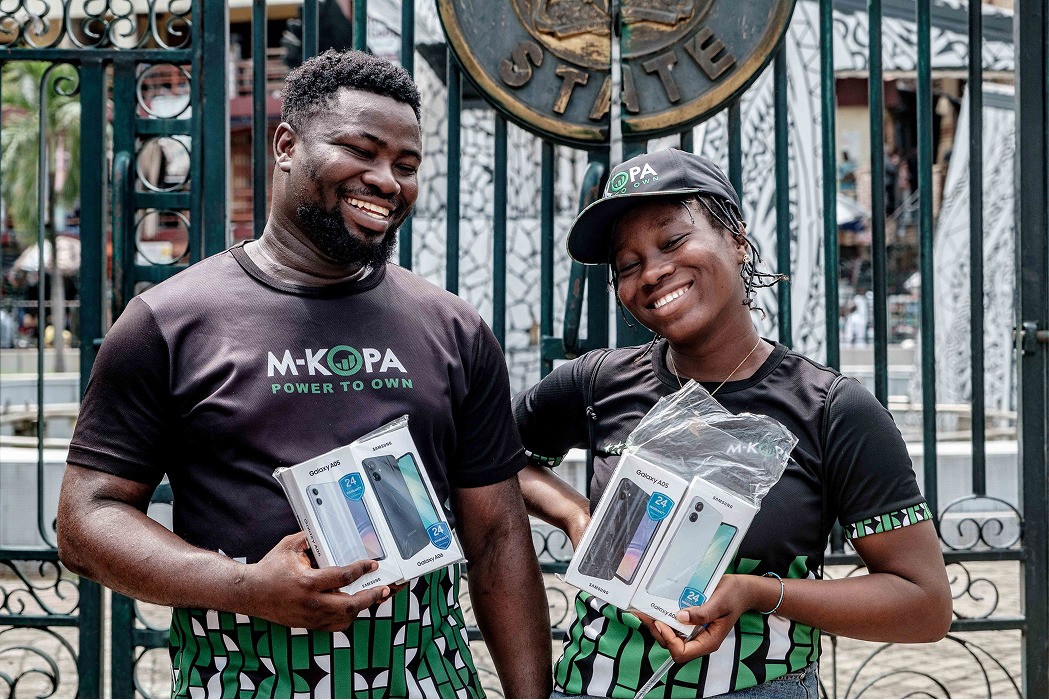
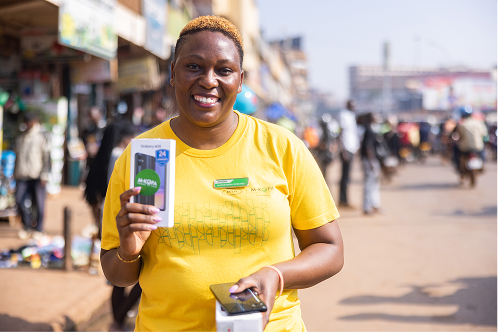
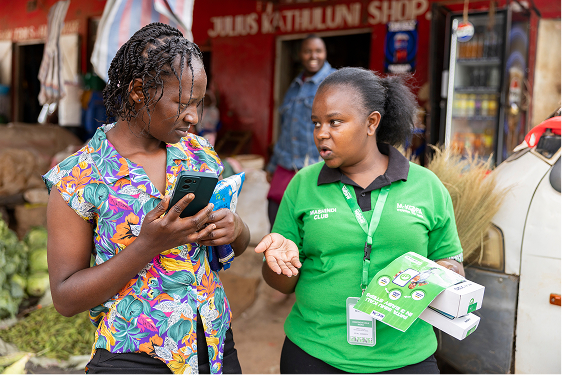
This is where M-KOPA's 35,000+ sales agents across five markets become crucial. They're not just salespeople, they're digital literacy coaches, troubleshooters, and trusted advisors.
When a first-time smartphone user in rural Uganda doesn't understand how to download WhatsApp, their M-KOPA agent shows them. When a market trader in Lagos wants to learn mobile money, their agent walks them through it. When a boda boda rider in Nairobi needs help setting up a ride-hailing app, their agent is there.
This human infrastructure is what makes digital inclusion real. Technology alone doesn't bridge the digital divide, technology plus trust plus training does.
"If She Can Do It, So Can I"
Rachel, a business owner in Kenya, puts it simply: "My M-KOPA phone has not only transformed my business but also my life. It has provided me with the tools I need to succeed, enabling me to provide better for my family."
Stories like Rachel's, Suliyat's, and Peace's create something powerful: social proof.
When your neighbor, sister, or fellow market trader gets a smartphone through M-KOPA and their business grows, you pay attention. When you see them making daily payments without stress, you realize it's achievable. When you watch them use WhatsApp to get more customers, you want the same opportunity.
This is how movements happen, through lived experience shared within communities.
The Infrastructure Behind the Revolution
M-KOPA has built:
- Partnerships with major telecom providers (MTN, Airtel, Samsung, HMD) to ensure device quality and network reliability
- A mobile money integration system that makes payments seamless across multiple platforms
- A device locking technology that protects both the customer and the company from default risk
- A 35,000+ agent network that provides last-mile distribution and support
- A data analytics system that assesses creditworthiness using alternative data (payment history, mobile usage patterns)
This infrastructure is what makes the impossible possible, putting smartphones in the hands of people traditional finance has ignored.
The Numbers That Matter: M-KOPA's Impact by the Data
Let's look at the full picture:
Device Access:
- 7 million+ customers across five markets
- 1.7 million+ first-time mobile internet users
- 290,000 first-time smartphone users in Nigeria
- 36% of Ghana customers were first-time phone owners
Economic Impact:
- $2 billion+ in credit unlocked
- 54% of customers earn more after getting a smartphone
- 77% of Nigerian customers use smartphones/loans to generate income
- 55% of Ghana customers use devices for income generation
Financial Inclusion:
- 52% of Nigerian women accessed their first formal loan through M-KOPA
- 81% of long-term Nigerian customers report improved household expenses
- 76% of Ghana customers say quality of life improved
Women's Empowerment:
- 41% of Ghana women customers were first-time smartphone owners
- 53% of Nigerian sales agents are women
- 33% of Nigerian customers are women (up from 29% in 2024)
These aren't just statistics. They're 7 million stories of transformation.
Get your M-KOPA Smartphone
If you're reading this on a smartphone, pause for a moment. Think about everything this device enables—communication, information, income, connection, opportunity.
Now imagine not having it. Imagine watching the world move online while you're stuck offline. Imagine losing customers because you can't be reached on WhatsApp. Imagine missing out on mobile money, digital loans, online learning, and countless other opportunities.
That's the reality for 76% of Sub-Saharan Africa. But it doesn't have to be your reality.
If you've been waiting to get your first smartphone—or upgrade to a better one—because you can't afford the upfront cost, M-KOPA has a solution.
.svg)


